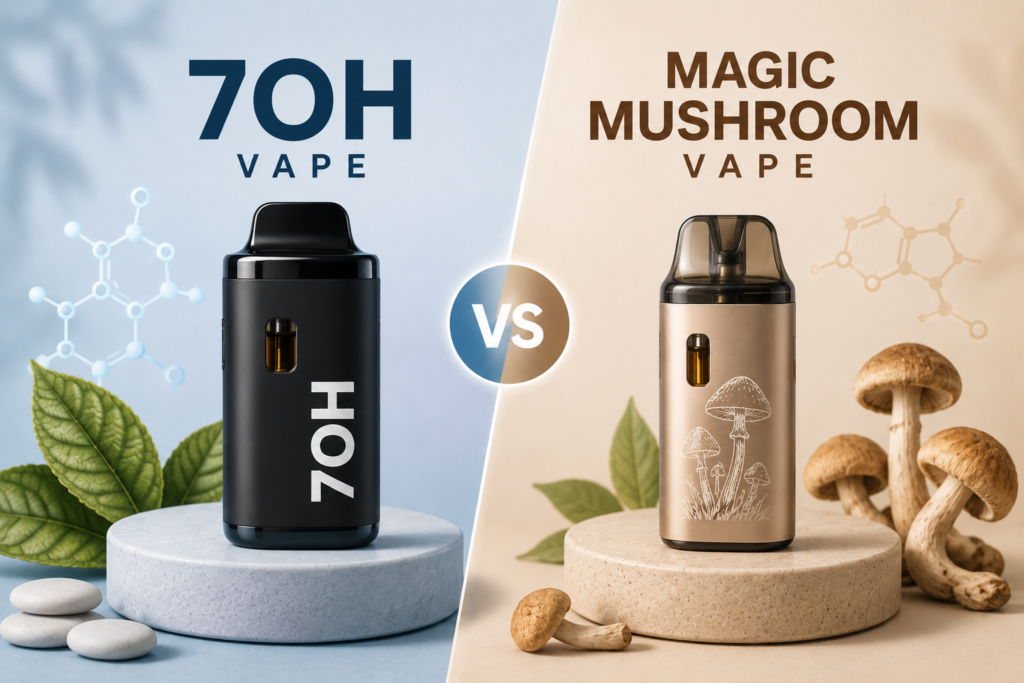
Vape products are no longer limited to nicotine or cannabis-style formulas. Today, shoppers may come across products marketed as 7OH vapes, kratom vapes, magic mushroom vapes, mushroom vape pens, or psychedelic vapes.
At first, these products may look similar. They may come in compact vape devices, colorful packaging, or smoke-shop displays. But the ingredients, legal status, safety concerns, and product claims can be very different.
This guide breaks down 7OH vape vs magic mushroom vape in simple terms so readers can understand what these labels may mean, what risks to watch for, and how to compare product transparency before making any decision.
Important note: This article is for educational purposes only. It does not recommend vaping 7OH, kratom alkaloids, psilocybin, muscimol, Amanita mushroom extracts, or any unapproved psychoactive substance. 7OH products are not FDA-approved for any medical use, and the FDA recommends consumers avoid 7OH products. Psilocybin is a Schedule I controlled substance under U.S. federal law.
Quick Answer: 7OH Vape vs Magic Mushroom Vape
A 7OH vape would generally refer to a vape product marketed around 7-hydroxymitragynine, also called 7OH or 7-OH, a concentrated kratom-related alkaloid.
A magic mushroom vape is a much less clear category. It may be marketed as containing psilocybin, psilocin, Amanita muscaria, muscimol, or a vague “mushroom blend.” In many cases, shoppers should be cautious because the label may not accurately explain what is inside.
|
Product Type |
What It Usually Claims |
Key Concern |
|
7OH Vape |
Vape format containing or marketed around 7-hydroxymitragynine |
7OH is not FDA-approved and FDA recommends consumers avoid 7OH products |
|
Magic Mushroom Vape |
Vape format marketed around mushrooms, psychedelics, Amanita, muscimol, or psilocybin-style effects |
Ingredients may be illegal, unclear, undisclosed, or unsafe |
|
Mushroom Blend Vape |
Broad “functional” or “psychedelic” mushroom branding |
Label may not clearly distinguish legal functional mushrooms from psychoactive compounds |
The biggest difference is this:
7OH vapes are tied to a kratom-related alkaloid category, while magic mushroom vapes are tied to a much broader and often more confusing mushroom or psychedelic product category.
What is a 7OH Vape?
7OH stands for 7-hydroxymitragynine, a kratom-related alkaloid. In natural kratom leaf, 7OH occurs in trace amounts, but modern 7OH products may contain added or enhanced levels. The FDA has specifically warned consumers about concentrated 7OH products, including products sold online and in smoke shops.
A 7OH vape would typically be marketed as a vapor product containing or associated with 7OH.
However, shoppers should understand one major point:
The FDA warning around 7OH is not limited to one format. The agency has raised concern around concentrated 7OH products generally, including tablets, gummies, drink mixes, and shots, and has stated that 7OH products have not been proven safe or effective for any use.
How 7OH Vape Products May Be Positioned?
Across the broader market, 7OH-related products may be marketed with language like:
- Fast-use format
- Portable
- Smoke-shop ready
- Kratom-derived
- Alkaloid-based
- High potency
- Alternative wellness
- Relaxation or mood-related language
Shoppers should be careful with these claims. 7OH is not FDA-approved for stress, anxiety, pain, relaxation, mood, opioid withdrawal, or any other condition.
What Is a Magic Mushroom Vape?
The phrase magic mushroom vape can be confusing because it may refer to several very different things.
It may be used to describe products claiming to contain:
- Psilocybin
- Psilocin
- Amanita muscaria
- Muscimol
- Ibotenic acid
- Functional mushroom extracts
- A proprietary mushroom blend
- Synthetic or undisclosed psychoactive compounds
This is why shoppers should not assume every “mushroom vape” is the same.
Psilocybin vs Amanita vs Functional Mushrooms
|
Mushroom Category |
Common Meaning |
Main Concern |
|
Psilocybin mushrooms |
“Magic mushrooms” containing psilocybin/psilocin |
Psilocybin is Schedule I under U.S. federal law |
|
Amanita muscaria products |
Products using muscimol/ibotenic acid |
FDA says Amanita muscaria and certain constituents are not authorized for use in food and may be harmful |
|
Functional mushrooms |
Lion’s mane, reishi, cordyceps, chaga, etc. |
Usually non-psychoactive, but vape safety and label accuracy still matter |
|
Mushroom blend products |
Vague branding around “shroom” or “mushroom” effects |
May contain undisclosed or unexpected compounds |
The FDA has warned that Amanita muscaria, its extracts, and certain constituents such as muscimol, ibotenic acid, and muscarine are not authorized for use as ingredients in conventional food and may be harmful.
7OH Vape vs Magic Mushroom Vape: Side-by-Side Comparison
|
Factor |
7OH Vape |
Magic Mushroom Vape |
|
Main Product Idea |
Vape marketed around 7-hydroxymitragynine |
Vape marketed around mushroom or psychedelic effects |
|
Primary Ingredient Category |
Kratom-related alkaloid |
Psilocybin, Amanita, muscimol, functional mushrooms, or unclear blends |
|
Legal Complexity |
7OH products face FDA warnings and enforcement scrutiny |
Psilocybin is federally controlled; Amanita/muscimol products face FDA safety concerns |
|
Label Clarity Risk |
May not clearly show 7OH amount or formulation |
May not clearly identify mushroom type or active compound |
|
Common Marketing Language |
Alkaloid, kratom-derived, high potency |
Psychedelic, microdose, mushroom blend, legal shroom |
|
Main Buyer Concern |
7OH concentration, format safety, FDA warnings |
Ingredient identity, legality, undisclosed compounds, product testing |
|
Medical Claim Risk |
Stress, pain, relaxation, opioid withdrawal claims |
Anxiety, mood, creativity, microdosing, psychedelic therapy claims |
Are 7OH Vapes Legal?
This is not a simple yes-or-no question.
The FDA states that 7OH is not approved for medical use and is not lawful as a dietary supplement or when added to conventional foods. The agency has issued warning letters to companies marketing 7OH products and has recommended scheduling action to control certain concentrated 7OH products under the Controlled Substances Act.
Legal status can also vary by:
- Country
- State
- County
- City
- Product format
- Product ingredient level
- Intended use claims
- Whether 7OH is added or enhanced
Before buying any 7OH vape or 7OH product, shoppers should check current local laws and product-specific restrictions.
Are Magic Mushroom Vapes Legal?
This depends on what the product actually contains.
Psilocybin, the main compound associated with classic “magic mushrooms,” is listed as a DEA Schedule I controlled substance in the United States. Schedule I substances are classified as having no currently accepted medical use in the U.S., lack accepted safety for use under medical supervision, and have high potential for abuse.
However, many products marketed as “magic mushroom” or “legal mushroom” products do not clearly contain psilocybin. Some may use Amanita muscaria or muscimol, while others may contain undisclosed ingredients.
That creates a major issue:
A magic mushroom vape may not actually contain what the branding suggests.
Why “Magic Mushroom Vape” Labels Can Be Misleading?
Many mushroom-branded products use vague terms like:
- Magic mushroom
- Shroom vape
- Legal psychedelic
- Mushroom blend
- Microdose vape
- Amanita blend
- Functional mushroom
- Euphoric mushroom
- Plant-based trip
These terms may sound descriptive, but they do not always tell the shopper what is inside.
A credible product label should clearly identify:
- Mushroom species
- Active compounds
- Amount per serving or device
- Whether it contains psilocybin or psilocin
- Whether it contains muscimol or Amanita extract
- Whether it contains cannabinoids, kratom alkaloids, kava, or other ingredients
- Lab testing information
- Warning language
- Legal restrictions
The CDC reported a 2024 outbreak linked to Diamond Shruumz mushroom products where testing identified multiple substances, including O-acetylpsilocin, psilocin, kavalactones, pregabalin, and muscimol. CDC also noted that psychoactive mushroom products may contain undisclosed ingredients, illicit substances, adulterants, or harmful contaminants.
Safety Concerns: 7OH Vape vs Magic Mushroom Vape
7OH Vape Safety Concerns
The main concerns around 7OH products include:
- Concentrated alkaloid exposure
- Addiction and withdrawal risk
- Unapproved medical claims
- Inconsistent labeling
- Lack of FDA approval
- Possible serious adverse effects
- Regulatory enforcement risk
The FDA says exposure to 7OH could result in serious harm and reports harmful effects associated with 7OH products, including addiction, anxiety, depression, gastrointestinal distress, insomnia, seizures, and withdrawal symptoms.
Magic Mushroom Vape Safety Concerns
The main concerns around magic mushroom vapes include:
- Unclear ingredients
- Psilocybin legality
- Possible undisclosed psychoactive substances
- Amanita/muscimol safety concerns
- Contamination or adulteration
- Lack of dosing clarity
- No reliable way to confirm what is inhaled without testing
The Diamond Shruumz outbreak is a clear reminder of this risk. CDC reported 180 illnesses, 73 hospitalizations, and 3 potentially associated deaths linked to recalled mushroom products as of October 31, 2024.
Vaping Adds Another Layer of Risk
Even before discussing 7OH or mushroom ingredients, vaping itself adds extra uncertainty.
A product designed for inhalation should be evaluated differently from a tablet, gummy, or edible because inhaled ingredients may affect the body differently than swallowed ingredients. Some substances that appear in oral products may not be appropriate or studied for inhalation.
Before considering any vape product, shoppers should ask:
- Is this ingredient tested for inhalation?
- Does the label show every active ingredient?
- Are there solvents, carriers, or flavoring agents?
- Is there a Certificate of Analysis?
- Does the COA test for contaminants?
- Is the product made by a transparent company?
- Are there clear age restrictions and warnings?
- Does the product make medical or psychedelic claims?
If the answer is unclear, that is a red flag.
How to Compare 7OH Vapes and Magic Mushroom Vapes?
1. Start With the Active Ingredient
Do not compare based on branding alone.
Ask:
- Does the 7OH vape clearly list 7-hydroxymitragynine?
- Does the mushroom vape clearly list psilocybin, psilocin, muscimol, Amanita, or functional mushrooms?
- Are the ingredients vague or proprietary?
- Does the product include cannabinoids, kratom alkaloids, kava, or other substances?
2. Check the Amount Per Serving or Device
For 7OH vapes, check whether the product lists:
- Total 7OH per device
- 7OH per puff
- 7OH per serving
- Total active alkaloids
- Other kratom alkaloids
For mushroom vapes, check whether the product lists:
- Mushroom species
- Active compound
- Amount per serving
- Amount per device
- Whether it is psychoactive
- Whether it contains controlled substances
3. Look for Third-Party Lab Testing
A trustworthy product should provide recent lab testing.
For 7OH products, testing should ideally check:
- 7OH content
- Mitragynine content
- Other alkaloids
- Heavy metals
- Microbial contaminants
- Solvents
- Pesticides
For mushroom vapes, testing should ideally check:
- Mushroom identity
- Active compounds
- Psilocybin or psilocin presence
- Muscimol or ibotenic acid presence
- Heavy metals
- Solvents
- Microbial contaminants
- Undisclosed drugs or adulterants
4. Avoid Medical Claims
Be cautious if a vape product claims to treat:
- Stress
- Anxiety
- Depression
- Pain
- PTSD
- Sleep disorders
- Opioid withdrawal
- Addiction
- Any disease or medical condition
These claims can be a major red flag, especially for unapproved psychoactive products.
5. Check Legal Restrictions
Before buying or using any 7OH or mushroom vape, check:
- Federal law
- State law
- Local law
- Product-specific shipping rules
- Age restrictions
- Controlled substance rules
- Whether the ingredient is lawful for inhalation products
6. Be Extra Careful With “Legal Psychedelic” Claims
The phrase legal psychedelic can be misleading.
A product may be called “legal” because it does not claim to contain psilocybin, but that does not mean it is safe, tested, or lawful in every use case. The FDA has said Amanita muscaria and certain constituents are not authorized for use in conventional food and may be harmful.
Which Is Safer: 7OH Vape or Magic Mushroom Vape?
There is no responsible way to say that either category is “safe.”
Both categories raise serious concerns:
- 7OH products are not FDA-approved, and the FDA recommends consumers avoid them.
- Magic mushroom vapes may involve controlled substances, Amanita/muscimol safety concerns, or undisclosed ingredients.
- Vape formats add inhalation-specific uncertainty.
A better question is:
Which product is more transparent, better tested, clearly labeled, legally available, and free from unsupported medical claims?
If a product cannot answer those questions clearly, it should be avoided.
Common Mistakes Shoppers Make
Mistake 1: Assuming “Vape” Means Fast, Simple, or Safer
Vaping does not automatically make a product safer or easier to control. Inhalation can create its own safety questions.
Mistake 2: Thinking All Mushroom Vapes Contain Psilocybin
Some mushroom vapes may claim to contain Amanita or functional mushrooms instead. Others may not clearly disclose what they contain.
Mistake 3: Ignoring FDA Warnings Around 7OH
The FDA recommends avoiding 7OH products and has taken enforcement action against concentrated 7OH products.
Mistake 4: Trusting “Legal High” Marketing
Legal language can be vague or misleading. A product can still be unsafe, mislabeled, or restricted depending on location.
Mistake 5: Skipping the Lab Report
For categories involving psychoactive compounds, vague labels are not enough. A current third-party lab report is one of the most important trust signals.
Mistake 6: Buying Products That Make Medical Claims
Claims around stress, anxiety, pain, depression, PTSD, sleep, or withdrawal are especially risky when attached to unapproved products.
Final Takeaway: Do Not Compare These Products by Branding Alone
When comparing 7OH vape vs magic mushroom vape, the packaging may look similar, but the categories are very different.
A 7OH vape is tied to 7-hydroxymitragynine, a concentrated kratom-related alkaloid category that has received FDA warnings. A magic mushroom vape may involve psilocybin, psilocin, Amanita, muscimol, functional mushrooms, or unclear proprietary blends. That makes ingredient transparency especially important.
Before considering either type of product, review:
- Active ingredient
- Amount per serving or device
- Lab testing
- Legal status
- Warning language
- Inhalation safety
- Medical claims
- Shipping restrictions
- Company transparency
For shoppers researching 7OH products, 7OH.com can help compare clearly labeled product categories by potency, format, and brand. But if a product is vague, untested, or making medical or psychedelic claims, the safest decision is to avoid it.
FAQs About 7OH Vape vs Magic Mushroom Vape
Q. What is a 7OH vape?
A 7OH vape would generally refer to a vape product marketed around 7-hydroxymitragynine, a kratom-related alkaloid. The FDA recommends consumers avoid 7OH products and states they have not been proven safe or effective for any use.
Q. What is a magic mushroom vape?
A magic mushroom vape is a product marketed around mushroom or psychedelic effects. It may claim to contain psilocybin, Amanita muscaria, muscimol, functional mushrooms, or a vague mushroom blend. The exact meaning depends on the label.
Q. Are magic mushroom vapes legal?
It depends on the ingredients and location. Psilocybin is a Schedule I controlled substance under U.S. federal law. Some products use Amanita or muscimol instead, but the FDA has warned that Amanita muscaria and certain constituents are not authorized for use in conventional food and may be harmful.
Q. Are 7OH vapes FDA-approved?
No. There are no FDA-approved products containing 7OH, and the FDA recommends consumers avoid 7OH products.
Q. Is vaping 7OH safer than taking 7OH tablets?
There is no reliable basis to say vaping 7OH is safer than tablets. Vaping adds inhalation-specific concerns, and 7OH products themselves are not FDA-approved and have received FDA warnings.
Q. Is a mushroom vape the same as a psilocybin vape?
Not always. Some mushroom vapes may imply psychedelic effects without clearly containing psilocybin. Others may use Amanita, muscimol, functional mushrooms, or undisclosed ingredients.
Q. What should I check before buying a 7OH or mushroom vape?
Check the active ingredient, amount per serving or device, lab testing, ingredient disclosure, legality, warning language, medical claims, inhalation safety, and shipping restrictions.
Q. Why are mushroom vape labels risky?
Mushroom product labels can be vague. CDC has warned that mushroom products may contain undisclosed ingredients, illicit substances, adulterants, or harmful contaminants.
Q. Which is better: 7OH vape or magic mushroom vape?
Neither is automatically better or safer. Both categories require caution, clear labeling, legal review, and third-party testing. Avoid products with vague ingredients, unsupported claims, or no lab documentation.